See alexwarren.xyz/ for contact and socials, ping me if it seems right.
Narrative Agency
Methods from network science to aid decisions in a complex world
Between Heaven and Earth
The I-Ching is an ancient binary system that relates yin and yang in progressive complexification, here hexagram 12 represents heaven above earth—nothing to be done; things are as they are.

Human life exists in the middle. One perspective on spiritual practice is that it is the art of breathing into the ground below our feet while opening to the world's vault.
This poetic form, has an interesting correspondence in complexity science, one of the core principles of which is dissipative systems. Textbook thermodynamics teaches equilibrium, but our very existence is tied into a non-equilibrium system, most obviously the sun. As its radiant heat shines on the earth, winds are whipped up as energy gradients organize matter into flows. Already at this most immediate stage of evolution, science is stymied by deep questions.
Complexodynamics
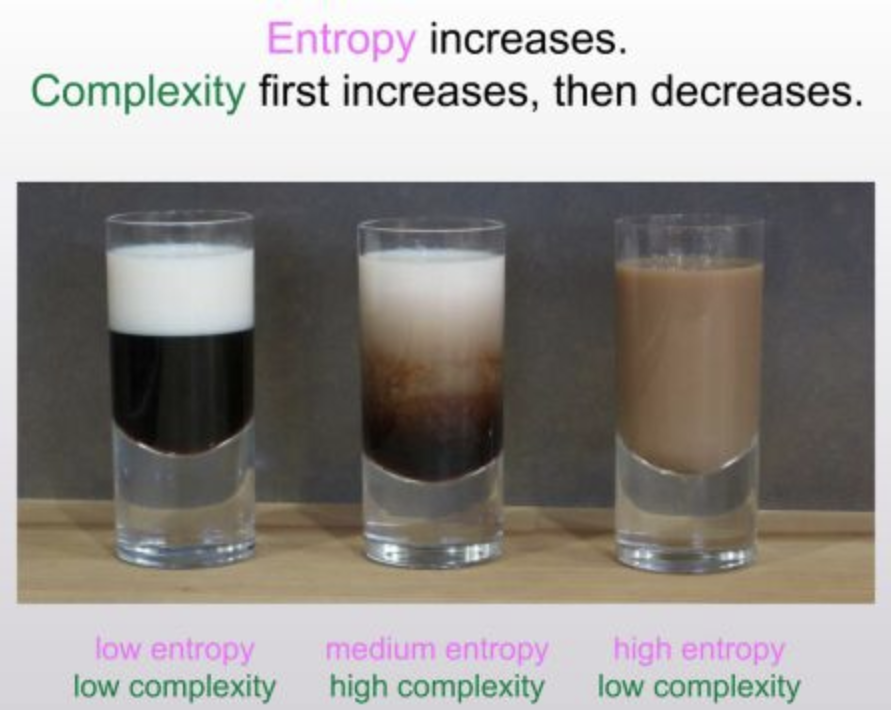
Clearly, the interesting stuff is happening in the middle. Fluid dynamics has been notoriously difficult to model, but that is the very situation that we human decision makers find ourselves in.
Naturalising sense-making
A core insight that Dave Snowden has demonstrated is twofold:
- Natural Science might not have answers but it is an excellent enabling constraint
- Ethnography allows us to build on our already existing human capacity to navigate complexity
At the Cynefin company, they have done amazing work in decision support for communities, businesses and governments. There is a wealth of resources, starting with the Cynefin wiki
Part of my inquiry has been how their principles interact with social network data.
Surfacing Affordances
Dave's Estuarine framework and Wayshaping, here are doing great work to frame decision problems in context with excellent perspectives in philosophy and science.
Here I got coaching by one of the Wayshaping authors, Mushfiqa Jamaluddin where we started with an inquiry into a domain of my life, and the narratives I had about it, the ecology and systems that make up my world. From there we worked out "Actants" that would be the organizing factors in my life situation, and then sequenced and sorted them based on how important and with how much effort it would take to change them.
This gave this energy landscape where the top right is "impossible" to change in the timeframe, bottom left is trivial, and the middle is the zone of optimal agency.
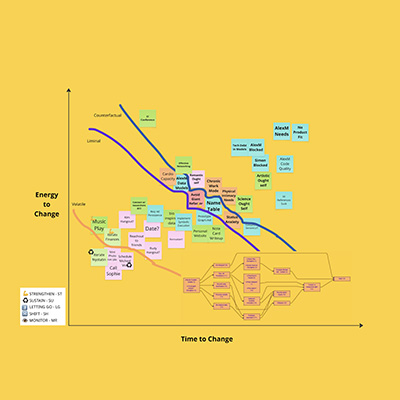
Already, this process generated a lot of insight for me, especially when I showed the map to people in my life, while some factors to me felt unchangeable, it was obvious to my CEO, that the move would be to break up the drivers of difficulty in to bite sized piece.
Another immediate occurence, is that after I made the map, many things changed, and I had a reorganization of my perceived affordances.
Narrative Networks
Given my background as a network enjoyer, I naturally made Actant Network!
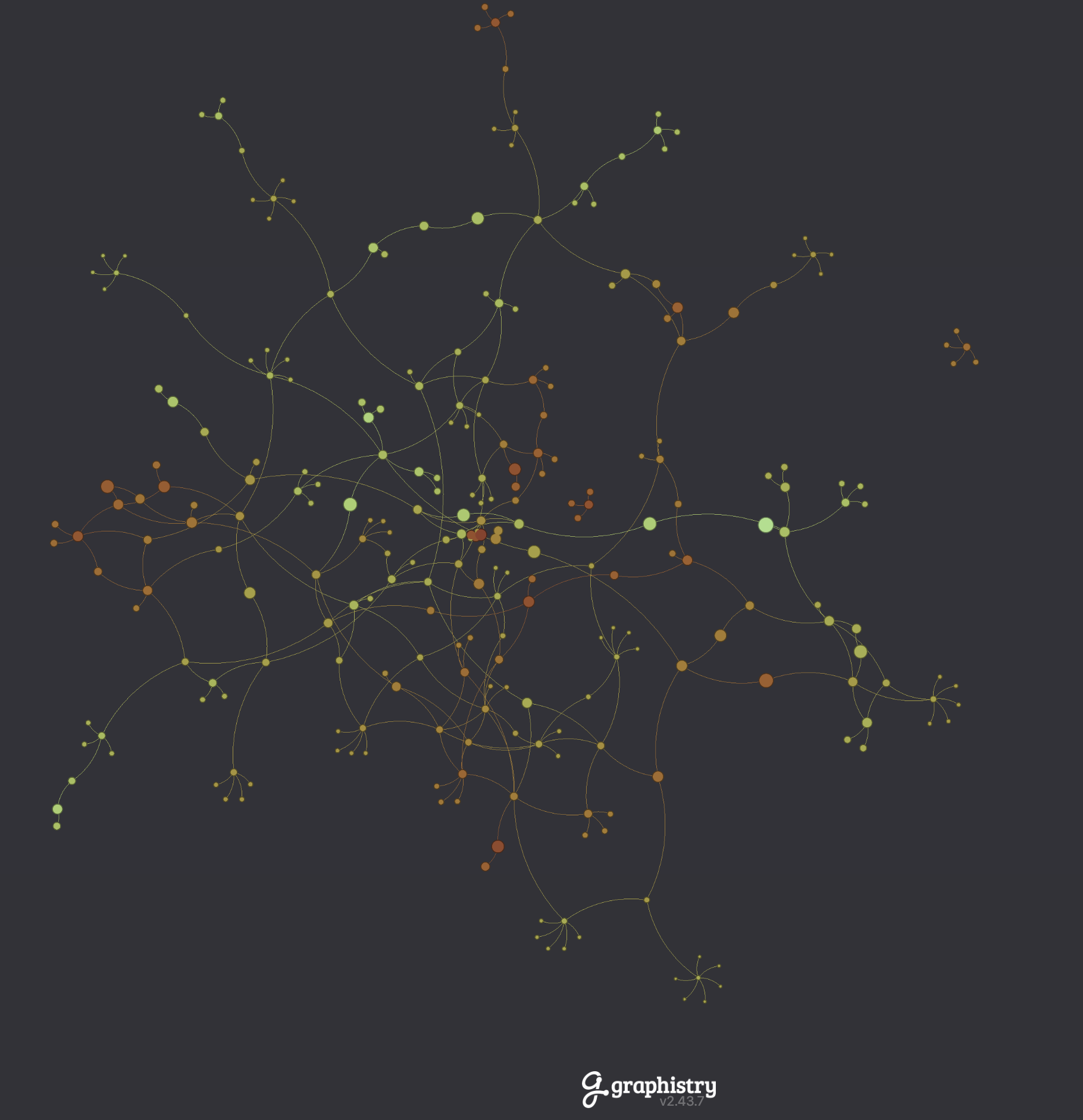
As another wayshaping exercise, I wrote narrative projections about my future, look at different scenarios whether I put effort into changing those aspects of my life. From there the process is to look at heuristics and try safe to fail experiments.
My riff was to take my stream of consciousness self narratives and then break them into utterances, ChatGPT helped me here to tag them with positive / negative affect in the spirit of PANAS-SF
Utterances:
- text: "After I've built a little muscle of just fucking sharing it, then I take the time to get my website a bit more organized when I actually have shit that I'm ready to just fucking share."
  refs: [creative.heaven]
  actants: ["Practice", "Just Share It", "Website", "Coherence", "Organization"]
  pa: 4
  na: 1
- text: "Cafes are a big part of my life."
  refs: [present.null]
  actants: ["Third Place"]
  pa: 4
  na: 1

Actants:
  "Third Place": "Constructor"
  "Cafe Writing": "Constructor"
From here I used pygraphistry and networkx to do diffuse the valence, so that I could get valence on each actant, which I normalized as well relative to a randomization.
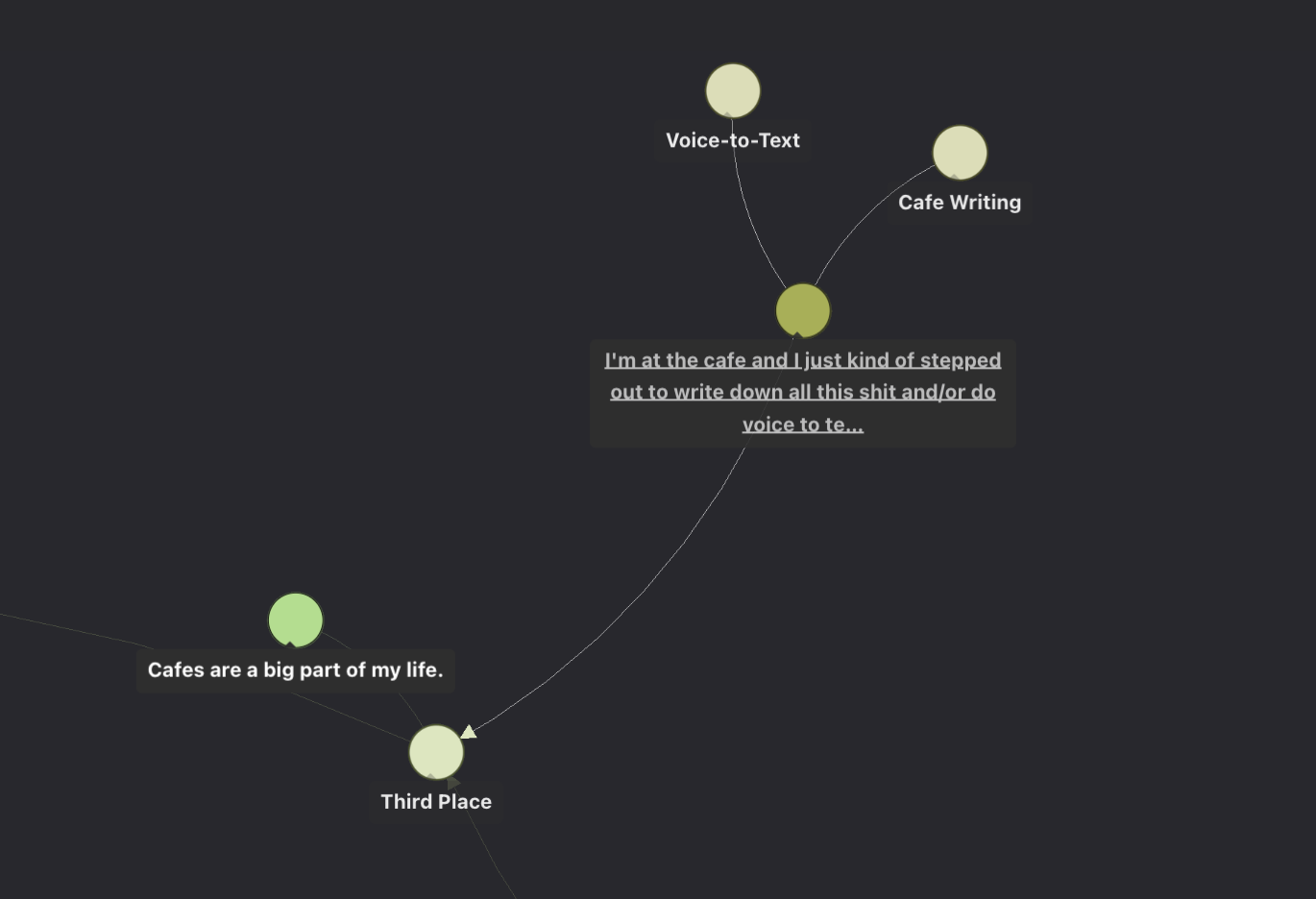
As we can see "Third Place" links by these two utterances and so we have the basis for a topological analysis. One of my hypothesis is that tracking transitions in the narrative structure of someone's life could be used as a narrative DNA. Then when evaluating interventions, we would be able to say "People with narratives like you" have benefitted from cathartic emotional practices, or even dietary or lifestyle interventions.
A benefit of the actant network is that it is possible to do a level of anonymization, so that we can be privacy perserving.
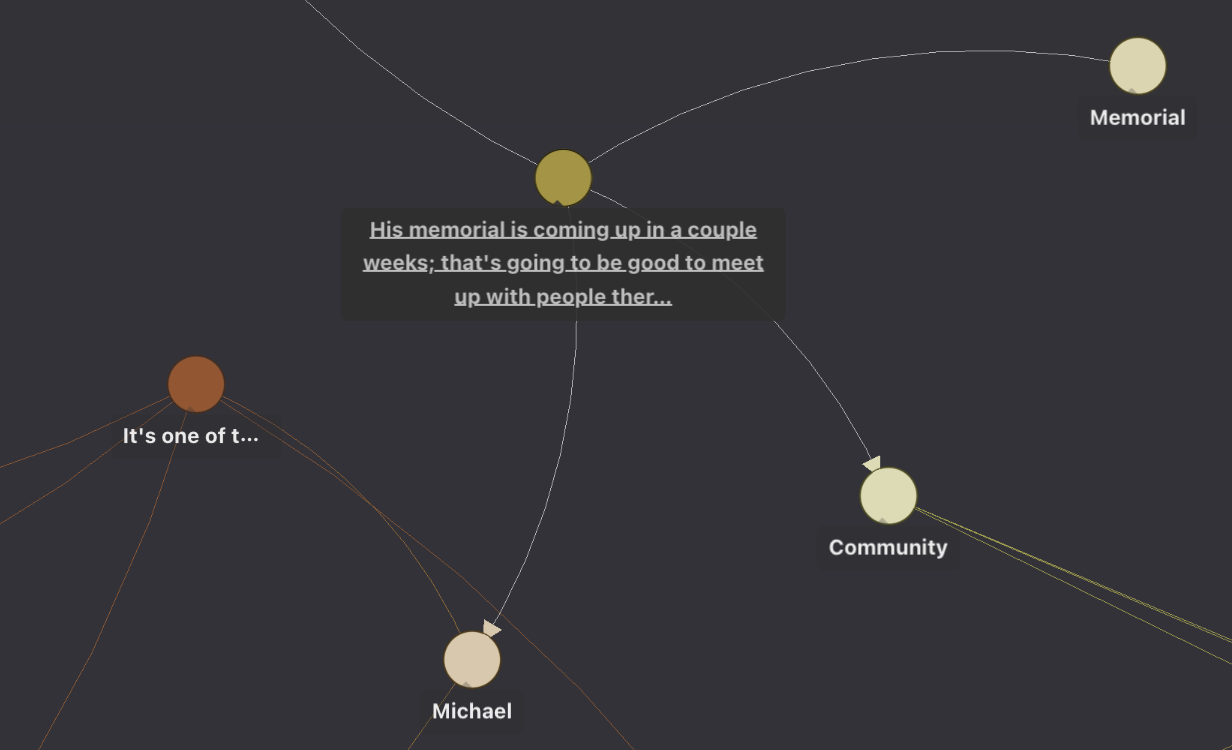
Naively, we might say diminish negative nodes and amplify positive nodes. But here we can see that my friend Encyclopedia/People/Michael Nagle is showing up with low affect, which is because he has passed away of cancer. The Actant network is a summary that collapses much of the complexity of situation, what is clear is that a charged node is salient. I can't help but think of this paper that combinations of positive and negative affect were associated with improvements in wellbeing [^1].
Collective Narrative
This is just the start, by having a representation like this, we can use the process from estuarine mapping to find the actants that a group can agree on, and then use those to tag ecologically collected narratives. From there the individuals can decide what they are comfortable sharing, a subset of their actants / affect as well as other variations, like ranking and proposing experiments. The buetiful thing is that the method is fractal, so a suitably self directed process could be used to crystalize collective action! That is the vision anyway, a lot of work and collaboration is needed to realize this, but the foundations are clear.
Open questions:
- How can the research into network science and dynamic systems interlink with this sort of approach?
- How to effectively surface an actant network in an async / rapid process?
- How to leverage ontological relationships between actants?
- How to represent narrative disagreement?
[^1] Mixed Emotional Experience Is Associated with and Precedes Improvements in Psychological Well-Being